

| Parsons Brinkerhoff Limited UK (formerly PB Kennedy and Donkin) | ||
 |
Post-tensioned
bridge investigation for The United Kingdom's Highways Agency. |
|
|
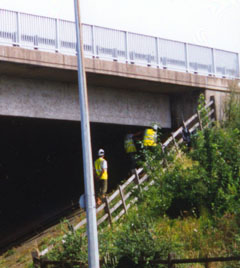
In an on-going programme since 1993, hundreds of post-tensioned concrete bridges have been earmarked for initial inspection and subsequent physical investigation. Jack Barfoot reports from a typical example. The Department of Transport (now called the Highways Agency) made an Order for the special inspection of certain post-tensioned concrete bridge decks and substructures. This following a growing awareness of cases of inadequate and incomplete internal grouting to tendon ducts in prestressed post-tensioned decks. Leakage of moist air, water or de-icing salts through the deck joints could consequently lead to significant corrosion of the stressing tendons. There are three stages of investigation for each bridge involved. A Preliminary Desk Study reviews documents to verify the bridge structure and indicate possible vulnerable locations. A Preliminary Site Inspection then provides a visual examination to identify distressed areas and to plan an investigation programme. The Site Investigation itself takes place after which the Project Manager reports on the structural condition of the bridge and any future monitoring requirements. Harlaxton Road Bridge in Lincolnshire carries the A1 Grantham bypass over the Grantham-Melton Mowbray (A607) road. It exemplifies what the inspections and investigations entail and how modern cover meter and probe equipments reduce on-site times and destructive drilling. The bridge, built in 1961, is a simply supported three-span structure with a skew of 37 degrees. Each span consists of a 200mm thick reinforced concrete slab supported by sixteen prestressed post-tensioned longitudinal precast beams. The beams are connected transversely at each end and at mid-span by reinforced concrete diaphragms. Two reinforced concrete piled abutments and two piled portal piers of five arches make up the substructure. The Preliminary Site Inspection produced no visual evidence of significant deterioration to the post-tensioned beams in critical areas. However, indications of water leakage at beam ends, over abutments and piers demonstrated that there was a potential for reinforcement and prestressing steel corrosion. It was recommended that site investigations should be undertaken to assess the extent and severity of any deterioration. Dr Donald Pearson-Kirk, an Associate of multi-disciplinary consultants Parsons Brinckerhoff Limited (formerly PB Kennedy and Donkin) was in charge of the investigative work, carried out by two teams each of two men. "What we are particularly looking for are signs of deterioration and pitting corrosion to the tendons, which would reduce their size and the efficiency of the prestressing. Unlike general rusting of reinforcement, which would lead to identifiable spalling of concrete, pitting corrosion is not necessarily visible without physical investigation". "The investigation falls into two main parts. First of all use of cover meters to locate the rebars to connect to take the half-cell potential measurements to quantify electrical activity within the concrete, and importantly obtain depths of cover measurements. Samples of concrete dust are taken at different depths and sent to a laboratory together with grout samples - to be tested for chloride ion content. Depth of carbonation penetration is also determined". "Then we carry out actual exposures of the ducts and tendons to find any visual evidence of deterioration in the duct, grout or tendon". An important factor in the investigation was the choice of equipments used, he pointed out. "We look for a covermeter which not only gives accurate measurement of cover but also provides a good estimate of bar size, easily and clearly read in all light conditions. This is vital for examination with minimal damage of those areas of a structure, particularly when no drawings are available. Speed and accuracy in a cover meter is economic because it cuts job time and vitally eliminates wrong-guessing. For these reasons we go not just for requipment which is up-to-date, but particularly seek an instrument which is at the cutting edge of microprocessor technology. The covermeter is a primary tool in bridge work - without it we would just be making time-wasting break outs to get information". The unit chosen for the Harlaxton Road Bridge was Elcometer P330 Covermeter, which exceeds both UK and European standards. Using pulse induction technology, the instrument can give either continuous fast scanning of bar sizes and cover or orthogonal precision measurement of single bars. It also features four-button control and one-handed operation where needed, combined with a back lit read-out and audible signal. A Protovale covermeter used with an inductive probe enables ducts to be located and approached safely. Out of place ducts, or ducts where no profile information has been made available, may be safely found. Remedial work will call for voids within ducts to be properly regrouted and for exposed tendons to be covered with a corrosion inhibiting coating. Exposed surfaces of investigative holes in the concrete will be sealed with a primer and made good with a proprietary repair mortar in layers not to exceed 40mm. Investigation of Harlaxton Road Bridge was carried out for the Engineering Consultancy Services of Lincolnshire County Council with P B Kennedy and Donkin, (now Parsons Brinckerhoff Ltd) as engineering consultants. Parsons Brinckerhoff Ltd website |