

|
1: Requirements to be met: Requirement
Solution Relevant
standard(s): original BS4408:Part1:1969 rewritten as BS1881:Part204:1988:
"Recommendations on the use of electromagnetic covermeters".
In these we find references to three different accuracy levels,
here referred to as L1 to L3:
3:
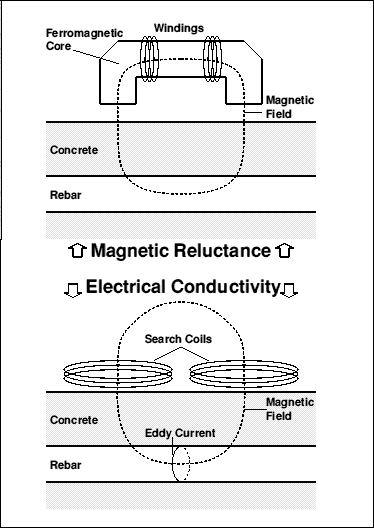
Magnetic Reluctance technique: "The
Covermeter" was first developed in 1955 at the (then) C&CA;
the principle then remained virtually unchanged for nearly thirty
years, and is still found in use today. See Figure 1a.
4: Electrical Conductivity technique: A magnetic
field (of similar shape to that above) is generated, of higher
frequency and using air-cored coils. This induces "eddy-currents"
to flow round the circumference of the bar which produce a signal
in the head (Figure 1b). Pulse techniques separate the received
signal from the transmitted one, so there is no signal in the
absence of a bar. This is the stablest technique. As always,
signal increases with bar size and decreases with depth of cover. Other
techniques are also used, with principles intermediate between
the two described above.
5: Bar location practice:
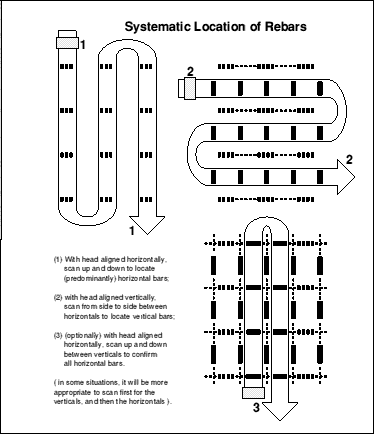
5.1: Single bars: See
Figure 2. The (directional) covermeter head is aligned parallel
to the expected run of the bar, and position optimised such
that there is: Alignment
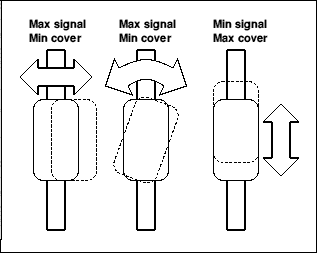
of the directional covermeter head is again the key (see Figure
3):
6: Measurement of concrete cover should
only be attempted when the covermeter head is: 6.1: Adjacent parallel bars:
6.2:
Neighbouring transverse bars: Minimum
necessary pitch-to-depth ratio is typically greater than the
1½:1 of §6.1 above due to finite head length. Generally, the
covermeter head should be positioned midway between two transverse
bars; but if they are too close, it may be better to position
the head directly over one (as opposed to partly-over two!):-
see Figure 5 to explain rule 5.1c earlier. Note:
if the covermeter head is not directional,
all the practices from §5.2 onward become much more difficult.
7: Welded mesh:
8: Unknown bar size: Everything
so far assumes that the bar diameter is known (to ±1 bar-size).
9: Lapped bars: These
give a larger signal than a single bar, so concrete cover is
underestimated. Lengthways scanning as in 5.1c will identify
them; to measure cover, assume a diameter twice that of a single
bar.
10: Various concrete covermeter head designs:
11: Various instrument styles: All are battery-powered and portable. Wide variations in ease of use (up a ladder as opposed to on the lab bench). Early instruments had an analogue meter (reading from right to left), and no audible output. Latest instruments have digital display, which is clearer for reading concrete cover but no use for bar location-- you must have an analogue indicator or signal-strength-related sound output for this.
12: Non-ferrous metals: Stainless
steel, being non-magnetic, is completely undetectable by magnetic
reluctance techniques, but it may give some signal on an instrument
responding to electrical conductivity. Since stainless steel
is also a very poor electrical conductor, signal strength varies
rapidly with bar size: the smaller sizes (8 and 10mm) are virtually
undetectable; larger sizes (20mm and up) may be detected, but
concrete cover will always be overestimated. Locators for stainless-steel
are available, but not (yet!) true concrete covermeters. Note
that epoxy-coated (high-tensile) bar is detected quite normally.
13: State of corrosion: This
can not be inferred using only a concrete covermeter--
a bar would have to lose well over half its bulk before a covermeter
would notice! (Half-cell potential and concrete-resistivity
surveys are used to estimate the rate of electrochemical activity
going on; and these need to be interpreted by tying their results
in with bar positions as determined by a covermeter survey,
so a covermeter still plays a part).
14: Commercially available concrete covermeter models, alphabetically by manufacturer: (a)
CNS covermeter: Fe-Depth meter (analogue) and later Digicover
(digital): magnetic reluctance method (Ucore), no audio. All
concrete covermeter manufacturers' current models naturally
claim conformity with BS1881 (§2) and do meet level L1 for a
single bar in isolation. The actual effects of bar congestion
(i.e. L2 or L3) need to be established by the user,
as brochure claims are not directly comparable. |
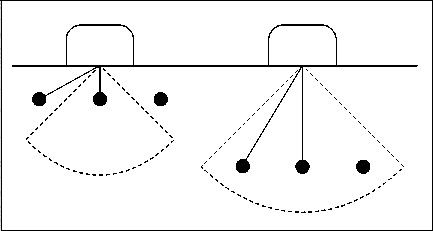 Signal decreases, not only with distance from the covermeter head,
but also with angular displacement off its centre-line: consider
the head to have a "field of view" (Figure 4).
Signal decreases, not only with distance from the covermeter head,
but also with angular displacement off its centre-line: consider
the head to have a "field of view" (Figure 4).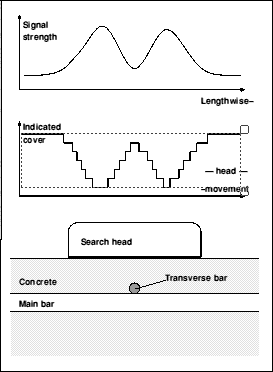
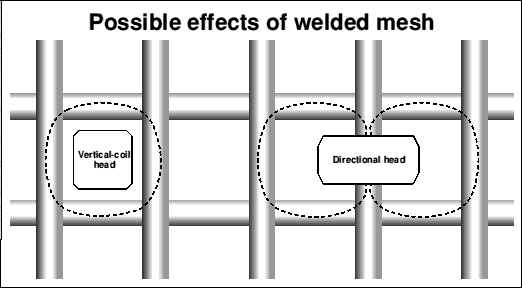 Everything about crossing bars applies, but if they are also electrically
connected at crossing points, other things may happen due to
currents flowing around rectangular "picture frames" (see Figure
6):
Everything about crossing bars applies, but if they are also electrically
connected at crossing points, other things may happen due to
currents flowing around rectangular "picture frames" (see Figure
6):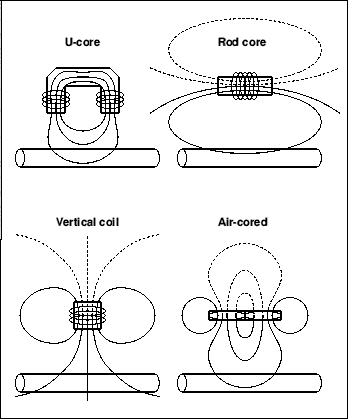 These are often offered in two different sizes. Some known designs
are shown in Figure 7:
These are often offered in two different sizes. Some known designs
are shown in Figure 7: